

March 2026 brought the most significant US regulatory statement on crypto in years, alongside a market that swung between a short squeeze and renewed geopolitical stress. The SEC published an interpretation describing which kinds of crypto assets fall outside securities law, bitcoin briefly approached $75,000 before slipping back as the conflict with Iran pushed oil higher, and listed bitcoin miners kept selling coins to fund debt reduction and a shift toward artificial intelligence data centres.
SEC publishes a token taxonomy, with CFTC support
On March 17, the Securities and Exchange Commission issued an interpretation clarifying how the federal securities laws apply to crypto assets. According to the SEC’s release, the interpretation sets out five categories of assets: digital commodities, digital collectibles, digital tools, stablecoins and digital securities. It also explains how a crypto asset that is not itself a security can become subject to an investment contract, and how that status can end, and addresses airdrops, protocol mining, protocol staking and the wrapping of non-security tokens.
The Commodity Futures Trading Commission joined the interpretation and said it would administer the Commodity Exchange Act consistently with it, which the SEC said should help market participants understand where the line between the two agencies falls. SEC Chairman Paul Atkins said that “most crypto assets are not themselves securities.”
Bitcoin tests $75,000 in a short squeeze
Bitcoin climbed to a peak of $75,653 late on Monday, March 16, US time, up roughly 4% in a day, before easing back to around $74,300, The Block reported. About $609 million of crypto positions were liquidated over 24 hours, including $485.6 million of short positions, a sign that traders betting on further declines were forced to buy back.
Fund flows were also supportive. US spot bitcoin ETFs took in $767.3 million of net inflows in the week before the rally, their third straight week of gains, and spot ether ETFs added $160.8 million. Easing fears over geopolitical tensions and oil-driven inflation helped risk assets, although Brent crude remained near $103 a barrel.
War risk and oil pull prices back
The rally faded within days. CoinDesk reported on March 23 that bitcoin had fallen back to about $68,200 after a weekend sell-off, returning to a range that dated back to early February after failed attempts to break above $75,000. The decline followed a threat by President Trump to destroy Iran’s power plants unless Iran reopened the Strait of Hormuz within 48 hours. More than $400 million of leveraged futures positions were liquidated in 24 hours, most of them longs, while the US dollar index moved back above 100 on inflation worries and a pause in the Fed’s rate-cutting cycle.
MARA sells 15,133 BTC to repurchase convertible notes
MARA Holdings said on March 26 that it had sold 15,133 bitcoin between March 4 and March 25 for about $1.1 billion, The Block reported. The proceeds were earmarked for repurchasing roughly $1 billion of principal of its convertible notes due 2030 and 2031 at about a 9% discount to par, saving an estimated $88.1 million before costs and cutting total convertible debt by about 30% to $2.3 billion. Before the sales, MARA held 53,822 BTC, and earlier in March it changed its treasury policy to allow sales from its balance-sheet holdings rather than only newly mined coins. Chief executive Fred Thiel said the transaction increases the company’s financial flexibility.
Miners pivot toward AI as margins shrink
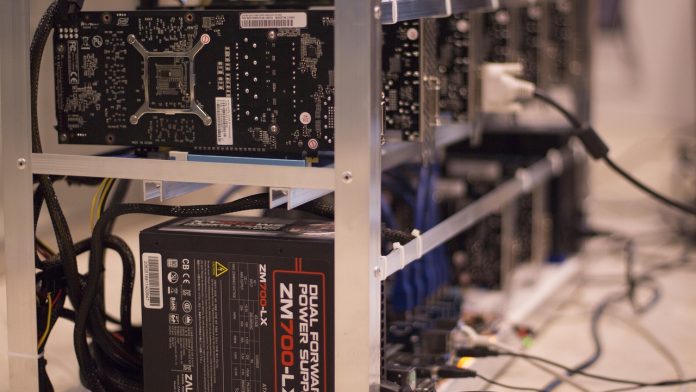
MARA was not alone. CoinDesk reported on March 27 that public miners had collectively reduced their bitcoin treasuries by more than 15,000 BTC from peak levels, with Bitdeer cutting its holdings to zero in February and Core Scientific planning to sell substantially all of its remaining coins in the first quarter. Hashprice, a measure of mining revenue per unit of computing power, fell to a post-halving low of about $28-30 per petahash per day in early March, according to the report, while CoinShares estimated the weighted average cash cost for listed miners at about $79,995 per BTC in the fourth quarter of 2025.
Many miners are redirecting power and capital toward AI and high-performance computing. CoinDesk cited more than $70 billion in cumulative AI and HPC contracts across the sector, including Hut 8’s $7 billion, 15-year lease at its River Bend campus, TeraWulf’s $12.8 billion of contracted HPC revenue and an expanded CoreWeave agreement with Core Scientific worth $10.2 billion over 12 years.
What to watch next month
- How exchanges, token issuers and ETF sponsors respond to the SEC’s taxonomy, and whether the Senate Banking Committee schedules its market-structure markup.
- Whether bitcoin can reclaim the mid-$70,000s or remains tied to oil and Middle East headlines.
- Further bitcoin sales and AI financing announcements from listed miners ahead of first-quarter earnings in late April and May.
This roundup is for general information only and is not investment advice. Cryptocurrencies are volatile; do your own research before investing.
Sources
- SEC Clarifies the Application of Federal Securities Laws to Crypto Assets — U.S. Securities and Exchange Commission, 2026-03-17
- Bitcoin rally tests $75,000 level in massive short squeeze — The Block, 2026-03-17
- Bitcoin retreats to $68,000, leaving CME gap as traders eye $70,000 rebound — CoinDesk, 2026-03-23
- MARA sells 15,133 bitcoin for $1.1 billion to fund convertible note repurchase — The Block, 2026-03-26
- Bitcoin miners are becoming AI companies and selling their BTC to fund the transition — CoinDesk, 2026-03-27
Featured image: rebcenter-moscow / Pixabay
